
Anyone who’s been a vendor at an outdoor market has had to deal with the problem of properly weighing their tent down.
At So Puzzled Puzzle Company, we originally didn’t take that as seriously as we should have. Most outdoor events seem to suggest at least 40 lbs of weight per leg. Our first-ever outdoor show recommended 40 lbs total and we just rolled with that.
Then the Howell Melon Festival got hit with a summer storm in the middle of Saturday in 2025. There were supposedly gusts up to 70 MPH. A lot of vendors were wiped out. We made it through largely because I was holding the tent in place myself. After things calmed down, we added one more set of disc weights and sandbags on every leg to get us up above 40 lbs per leg.
But two sets of disc weights and a set of sandbags were a pain to deal with. And at Tulip Time earlier this year, with high winds once again, the tent was rocking a bit more than we were comfortable with. So we decided to put together those concrete-in-PVC homemade weights that a lot of vendors use.
When I started looking into it, though, there were two things that stuck out to me. One was that it seemed like most people were taking up more of their booth footprint than seemed necessary to me. The other is that the “$50 for a set of four” price I was seeing didn’t make sense at all. So I want to run through how I did it and what it cost in case it helps anyone else.
For the uninitiated, the idea is that you take about 24 to 30 inches of PVC pipe (usually 4-inch pipe, specifically), cap one end, fill it with concrete, drill a hole in another cap for the other end, pop an eye-bolt in it, and let the concrete dry. Then you’ve got a weight you can attach to your tent with some kind of hook through the eye-bolt.
I’ve also seen versions without the caps. And if you do that, yeah, the price point might make sense. You’re looking at $16.38 for ten feet of 4″ PVC, cut down into four pieces. Another $6.24 for an 80 lb bag of concrete. Maybe you can get away with a 50 lb bag to save some money but you’re at $22.62 right there. Eye-bolts at $2.98 apiece means another $11.92 for a running total of $34.54.
Not bad, but we’re missing a piece. The caps. It’s another $7.25 for each of those. So lets say we’re only capping the bottom. One cap for each tube is $29, almost as much as we’ve paid for everything else combined at this point and putting us at $63.54 total, solidly over that $50 price point.
All of these prices are current as of this writing between Lowe’s and the Home Depot.
There’s also one other problem. Each of these weighs a touch over 20 lbs. That means you actually need eight total weights to get the 40 lbs per leg we’re looking for. So double that price.
My version required more materials. Over-engineered is how I do things.
I didn’t like the idea of two weights hanging next to each other, taking up extra space. I wanted to stack them, one on top of the other. This means that I needed four weights with eye-bolts in both (capped) ends and another set of four weights with eye-bolts only on the top end, plus an s-hook between each one to connect them.
I started the same as the previously-described method. Ten feet of PVC cut into four tubes. I did that twice to give me eight total weights. Then I punched half-inch holes in 12 of my 16 caps. I ran the eye-bolts into those holes and put a washer between two nuts on the end of the bolt for a little bit more grip in the concrete.
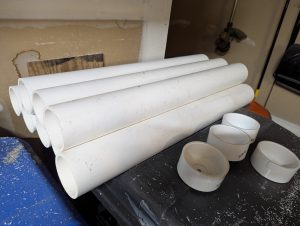
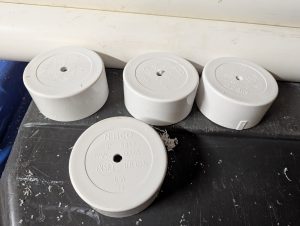
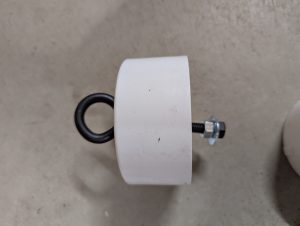
I had to build a bit of a rig from some scrap wood to hold up the “top” weights as they wouldn’t exactly stand up nicely with the eye-bolts sticking out of each end. Once that was done, I “just” needed to fill each tube with concrete. I say “just” because my autistic self has some difficulty with messy projects so the concrete was a little hard for me to work with. Eventually Jenny got tired of how slowly I was moving and took part of that over.
The upper cap popped on after the concrete was done. I didn’t use PVC glue to seal any of it because I didn’t need it to be watertight but I did use construction adhesive because I had some of that sitting around.
I was feeling a little paranoid about the eye-bolts not being surrounded by concrete well enough so, partway through the curing process, I flipped everything over so that the concrete could settle around the bolts that had been at the top of each weight.
A week later, we were in Grand Haven for the Merchants and Makers at the Coast Guard Festival show, with the new weights working exactly as expected. A few times through the weekend I gave our tent a bit of a push and it felt significantly more solid.
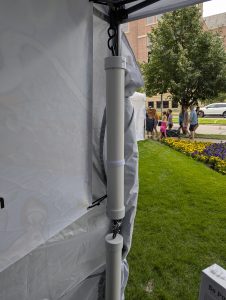
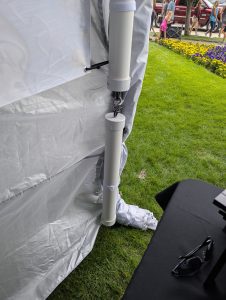
We used tow straps run from the middle of the frame to the corner to carry the weight. Velcro straps held the weights up against the leg to keep them from swinging around.
To be clear, I’m not saying this is the definitive way to do this. At the very least, the combined weight for each set came out to about 45 lbs and I know there are vendors who recommend even more than that, so this wouldn’t work for such a setup.
This does at least share some issues I had along the way and I hope that helps the next person to give this a shot.